Here are the key elements that make Green Mountain Financial Services Inc. stand out
Explore FAQs →

Green Mountain Financial Services Inc.

GlidePath to Retirement helps you create a personalized, rules-based asset allocation that de-risks as retirement nears. Model year-by-year shifts from equities to fixed income, coordinate RRSP/TFSA accounts, and compare current vs target portfolios to reduce volatility while staying on track for retirement income.

Green Mountain Financial Services Inc.
Your Trusted Partner in Insurance, Investments & Group Benefits
GlidePath to Retirement
20 yrs

Current Investments

Preset:
Total: 100%
Adjust allocations (dropdowns + fine control)

Target (GlidePath)

Total: 100%
Adjust allocations (dropdowns + fine control)
Done

Short on time? Prefer a quick conversation? Start with a 15-minute clarity call.

No pressure • Quick conversation • Book instantly

CFP® & EPC guidance • Independent advice • No obligation

Advanced Financial Planning

Need a more structured financial plan?

Skip the quick enquiry and complete our detailed financial intake for more tailored guidance on investments, retirement planning, and long-term strategy.

Begin My Financial Intake →
Takes 3–5 minutes • No obligation • Completely confidential

GlidePath to Retirement – Smart, Automatic De-Risking Toward Your Goal

A glidepath gradually shifts your portfolio from growth to preservation as retirement approaches. Use the tool above to model your target mix and see how allocations evolve year-by-year.

What is a GlidePath?

A glidepath is a rules-based schedule that shifts your asset mix from higher-risk, growth assets (e.g., equities) toward lower-volatility assets (e.g., fixed income and cash) as your retirement date nears. The intent is to capture growth when there’s time to recover from market dips, then gradually protect capital and income stability as you approach (and enter) retirement.

Many target-date funds use glidepaths, but a custom glidepath lets you tailor the pace of de-risking to your personal timeline, tax shelters (RRSP, TFSA, LIRA, etc.), and risk capacity.

How the GlidePath Tool Works

  • Years to Retirement: Move the slider to set your horizon (e.g., 20 years).
  • Follow GlidePath: Toggle to apply the model’s target allocation for each year.
  • Copy Current ↔ Target: Instantly align your “current” vs. “target” pies to compare before/after.
  • Adjust Allocations: Fine-tune asset classes to reflect your products (mutual funds, segregated funds, ETFs) and constraints.
  • Snapshot & Chart: Review the year-by-year table and trend chart to visualize equity and fixed-income slopes.

Need help choosing the right slope? See our Investment Planning Services or book a call.

Who Is a GlidePath For?

  • Savers who want a disciplined, emotion-free approach to de-risking.
  • Investors approaching retirement who want less volatility without abandoning growth.
  • Households coordinating RRSP/TFSA/non-registered accounts and pension/CPP/OAS timing.

Tips & Best Practices

  • Rebalance regularly: At least annually or on threshold bands to keep the glidepath on track.
  • Coordinate with cash-flow: Align with expected CPP/OAS and pensions (Government of Canada – CPP).
  • Stress-test: Review downside scenarios and sequence-of-returns risk (Investor.gov – Understanding Risk).
  • Tax-aware drawdown: Integrate your glidepath with RRSP/RRIF, TFSA, and non-registered withdrawal order.

Continue with our related guides: Investment Planning Strategy, Financial Wellness, FAQs, and Insights Blog.

GlidePath to Retirement – Frequently Asked Questions

What is the main benefit of a glidepath?

It automates de-risking, helping you capture growth earlier and reduce volatility as retirement nears—without constant decision-making.

How do you choose the right slope?

It depends on your time horizon, savings rate, pensions/CPP/OAS, risk capacity, and the need for inflation-adjusted income. We calibrate this during a planning session.

Does a glidepath replace rebalancing?

No. The glidepath defines targets; periodic rebalancing (calendar or tolerance bands) keeps your actual allocation aligned.

How often should I review my glidepath?

At least annually and after major life events—retirement date changes, new income sources, large deposits/withdrawals, or market regime shifts.

Can I use this with RRSPs, TFSAs, and non-registered accounts?

Yes. We coordinate across accounts and tax treatments to maintain the desired risk level while optimizing after-tax outcomes.

Is this financial advice?

This tool is educational. Recommendations depend on your personal situation. Speak with an advisor to get tailored guidance.

Ready to tailor your GlidePath? Schedule a Free Consultation

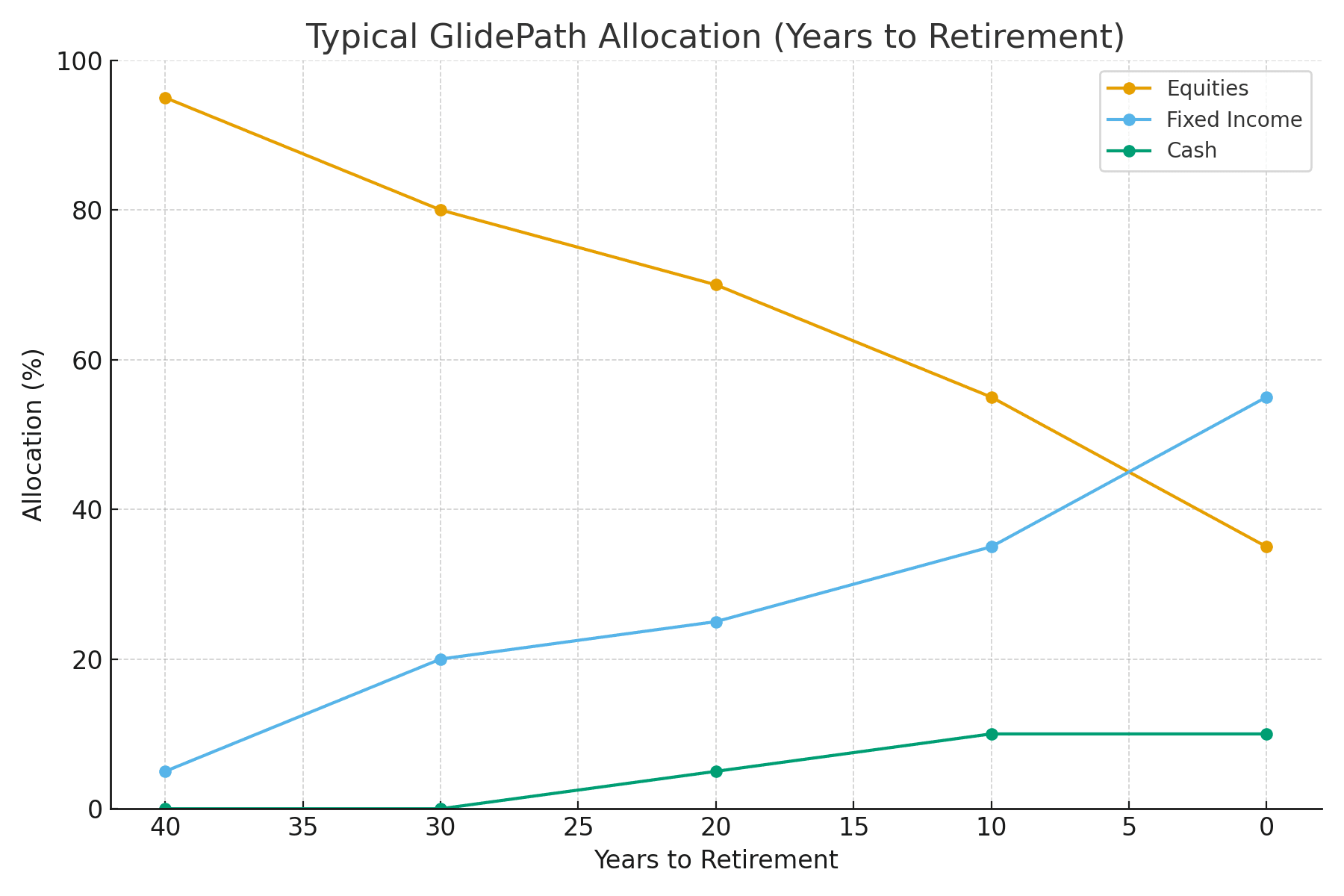
Typical GlidePath Allocation

How a portfolio shifts from growth to preservation as retirement approaches.

Equities decline from ~95% at 40 years to ~35% at retirement; Fixed Income rises from ~5% to ~55%; Cash rises to ~10% near retirement.

Illustrative only. Actual allocations should reflect risk tolerance, liquidity needs, and client objectives.

Tax Efficiency Tool

Could your financial structure be more tax-efficient?

Use this quick educational snapshot to see where investments, insurance, retirement income, corporate wealth, or estate planning may deserve a closer review.

Start My Tax Efficiency Snapshot → Educational • Confidential • No obligation

Stay informed with practical financial planning insights for Canadians

Helpful updates on retirement planning, insurance strategies, investments and group benefits for individuals, families and business owners.

Receive practical insights designed to help you plan smarter, protect your future, and retire more confidently.

Short on time? Prefer a quick conversation? Start with a 15-minute clarity call.

No pressure • Quick conversation • Book instantly

CFP® & EPC guidance • Independent advice • No obligation

Partners & Carriers We Work With

Independent access to multiple leading insurers across Canada.

Logos are trademarks of their respective owners and are used for identification only.
Start Here →